Internal laboratory portal: from request to finished test report
The task
An accredited laboratory analyses industrial emissions, wastewater, natural water and soils. A sample travels a long way: the client's request, the sampling report, the referral to the lab, the test report, submission to the federal information system. Today all of this rests on Word, Excel and staff memory.
Requests arrive as scans and free-form emails. A manager copies sampling points and parameters out of them, and before a site visit an engineer puts together the sampling report again, checks which instruments are free and whether their calibration has expired. At every step the same data is typed in by hand once more.
Before designing anything, we went to the laboratory and watched how the chemists and samplers work, rather than only talking to management.
Request via a link
The manager sends the client a link, and the client fills in the request themselves: the site, sampling points with coordinates on a map, the required parameters from the laboratory's catalogue. If a parameter is missing, the client can type it in, and the manager decides whether to subcontract it. The system checks mandatory fields according to accreditation rules: a wastewater sample can't be sent for approval without the inspection well number.
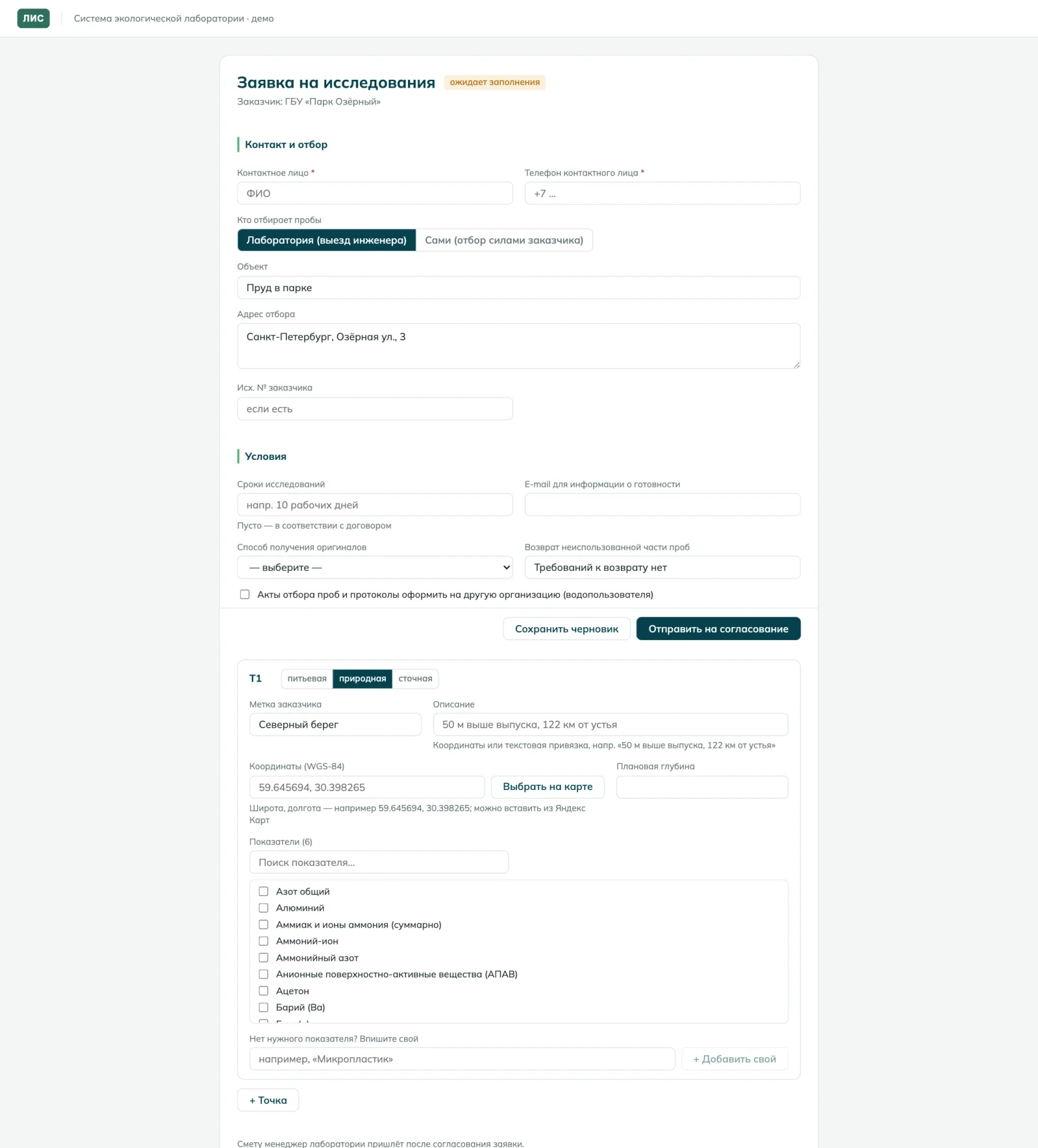
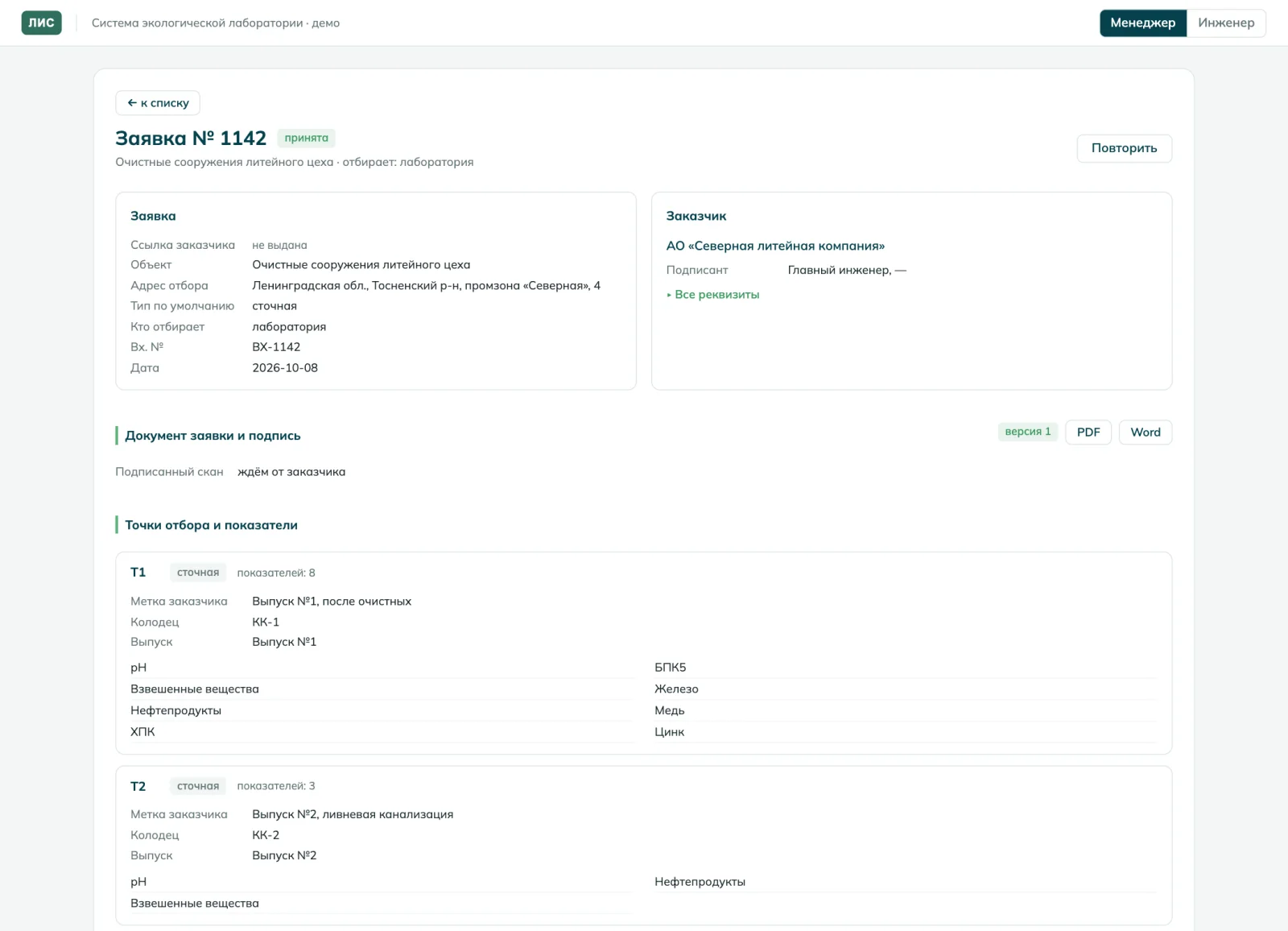
An approved request becomes a PDF and Word document; the client signs it and uploads the scan to the same place. The estimate is calculated from the laboratory's price list automatically.
A scanned request in half a minute
Many clients still send paper. AI reads the scan and builds a draft request in under 30 seconds. The manager sees flags where a decision is needed: a parameter not found in the catalogue, water type not specified, coordinates that don't add up.
Personal data never goes to the model. Before sending, the system finds and masks names, phone numbers, email addresses, bank details and signatures, and then runs recognition again on the masked page. If anything resembling personal data is still there, the page isn't sent to the model. There hasn't been a single leak on real scans, and every masking error found along the way has a regression test. The system has more than 160 automated tests in total.
Sampling report
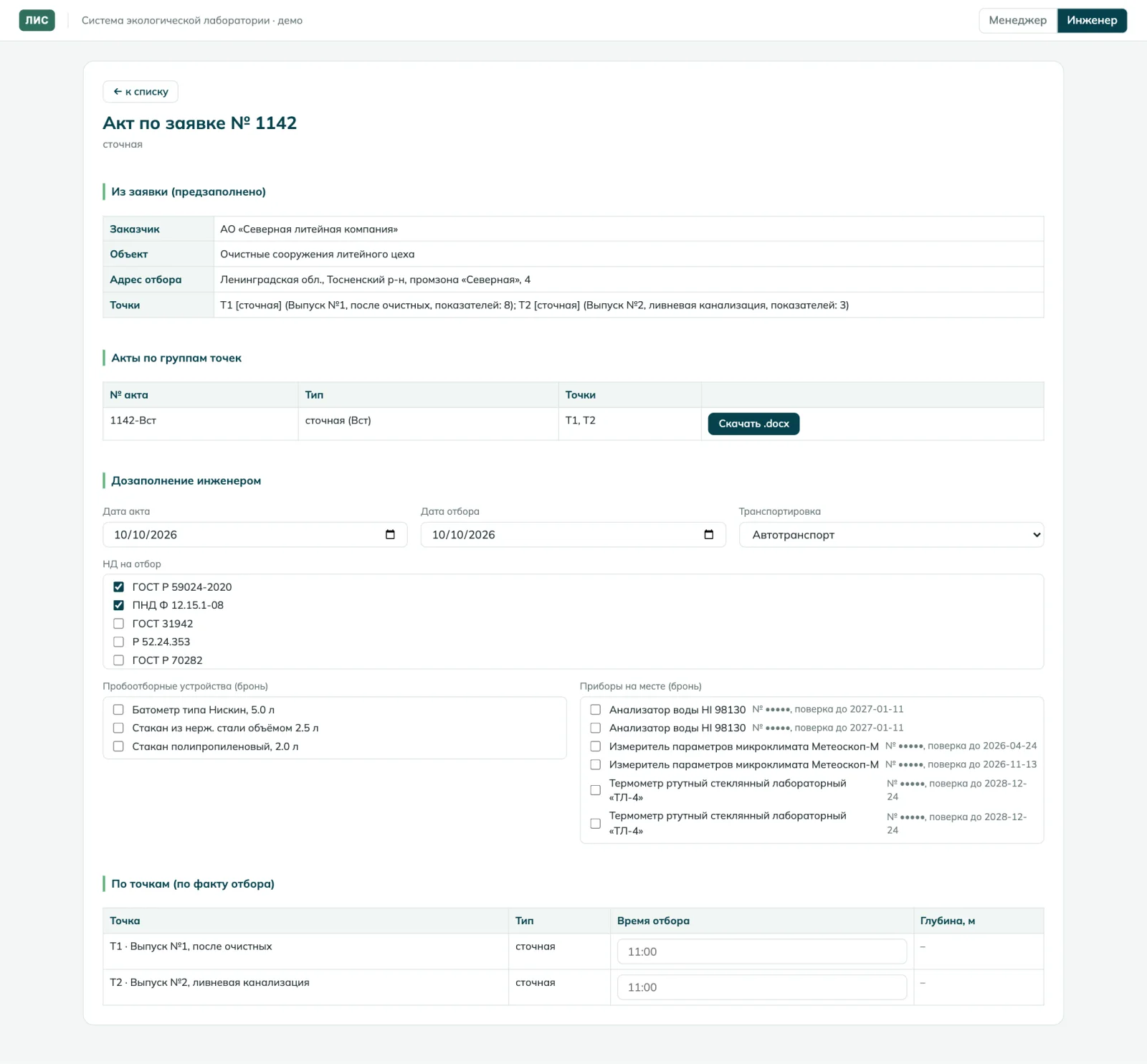
The engineer opens an accepted request, and the sampling report is already filled in: client, site, address, points. All that's left is to choose the sampling standard, tick the samplers and instruments and enter the sampling time. Each instrument shows its calibration date, and instruments are booked for the visit date. The report downloads in Word using the laboratory's template.
The red line
We don't design any feature for editing measured values "to get the right number" at all. Results are calculated only by deterministic algorithms with tests. AI explains, checks the paperwork and parses incoming documents, but never interferes with measurement results. Correcting a genuine error is done through a log entry, and the original value isn't erased. For an accredited laboratory this is a question of survival, not taste.
Who it's for
For the same laboratory we previously built a Telegram bot that assembles commercial quotes. Suitable for accredited laboratories that want to move off Word and Excel without changing their quality management system.
We'll show the system on your requests and sampling reports. We'll start with the part of your process where the most data is copied by hand.